
Your fitness tracker collects an impressive amount of data throughout the day, but making sense of all those numbers can feel overwhelming. From step counts to sleep cycles, each metric tells a unique story about your health and activity levels. This guide will demystify these measurements and show you how to use them effectively in your fitness journey.

Understanding Basic Activity Metrics
Step Count: More Than Just Walking
Your daily step count serves as a fundamental measure of physical activity. Most fitness trackers use motion sensors to detect arm movements and calculate steps. While the commonly cited goal of 10,000 steps provides a good target, your ideal step count should align with your personal fitness objectives.
Key points about step tracking:
How trackers detect steps: A MEMS (micro-electromechanical system) 3-axis accelerometer is used to measure changes in the device’s speed. When you walk, at least one axis will have relatively large periodic changes in acceleration, which will be tallied as steps. Some devices use gyroscopic motion sensors along with the accelerometer for more accurate results.
Accuracy considerations: The quality of the software algorithms used to interpret the movement data vary wildly between tracker makers. For example, a high-quality algorithm will look for a short spike of deceleration, indicating when your foot has hit the floor. Others just measure periodic changes. Understand too that step counts are easily thrown off by changes in walking style or ‘exuberant’ gesticulation, so will always be an approximation.
Setting personalized step goals: Be realistic about your current health condition, then 1. Set a time e.g. I will start on Saturday and follow this plan for three weeks. 2. Set a measurement e.g. I will walk 10 minutes a day, three days a week. 3.Set an improvement target e.g. I will add 2 minutes to each walk.
Impact on overall health: track your data, even if it is only on paper, so you can see and understand the improvements you are making.
Calories Burned: The Energy Equation
Fitness trackers calculate calorie burn using several factors:
Basal metabolic rate (BMR): The rate at which you burn calories while at rest to maintain vital functions like breathing and blood circulation.
Activity level: Measured by accelerometers and sometimes gyroscopic motion sensors.
Heart rate data: optical heart rate sensors monitor pulse rate to determine your cardiovascular effort.
Personal statistics (age, weight, height): these go toward determining your BMR.
Understanding your calorie burn helps create realistic fitness and weight management goals. Remember though, a calculation is used to estimate your calorie burn and there’s no requirement on manufacturers to publish their algorithms or verify the accuracy of their calorie counts. A Stanford study found that fitness trackers accurately measure heart rate but overestimate calorie burn by anywhere from 27 to 93 percent.
Advanced Health Metrics
Heart Rate Monitoring
Your heart rate provides crucial insights into your fitness level and overall health:

Resting Heart Rate
Normal ranges: for adults ranges from 60 to 100 beats per minute.
Factors affecting resting heart rate: Age, fitness and sex (Women generally have a higher resting heart rate than men) are major factors. Other influences include: caffeine, alcohol, and nicotine intake; medications (e.g. beta blockers) or medical conditions (e.g. infection); dehydration; disrupted sleep; strong emotions (e.g. fear, anxiety).
Measure accurately: Sit down and rest for at least five minutes before taking readings.
Heart Rate Zones
For men, maximum heart rate is calculated as 214 minus 0.8 times age, and for women it’s 209 minus 0.7 times age. The simpler (and more common) method is to subtract a person’s age from 220. For example, if a person is 30 years old, their maximum heart rate would be 190 beats per minute (BPM). Modern training science suggests five exercise or training zones given as a percentage of the maximum heart rate:
Zone 1: Warm-up (50-60% max HR): Perfect fitness zone for beginners.
Zone 2: Fat burn (60-70% max HR): Calories burnt from fat. Strengthens circulatory system and improves fitness.
Zone 3: Cardio (70-80% max HR): Aerobic zone. Ideal for increasing endurance.
Zone 4: Peak (80-90% max HR): Anaerobic zone. Competitive athletes train for short periods in this range for maximal performance increase.
Zone 5: Maximum effort (90-100% max HR): Red zone. Best avoided by recreational athletes!
Sleep Tracking
Modern fitness trackers analyze your sleep patterns through:
Movement patterns: You guessed it – using accelerometers!
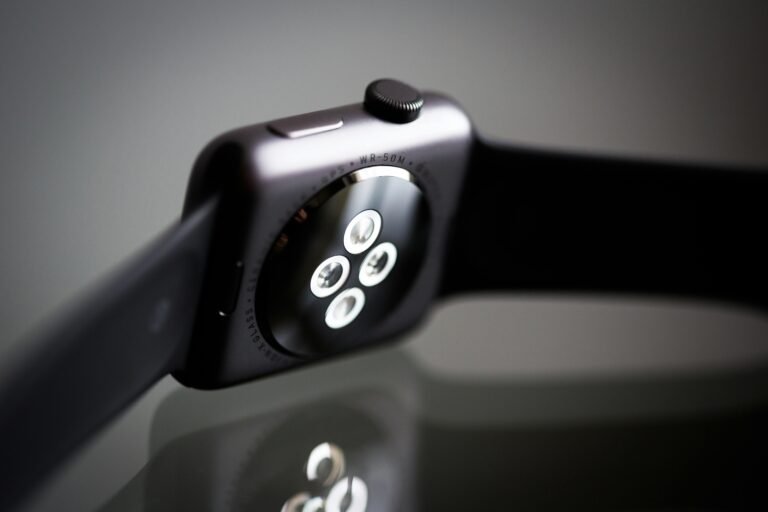
Heart rate variations: Usually measured optically with photoplethysmography (PPG) sensors that shine infra-red or green light through the skin. The light is more strongly absorbed by blood than the surrounding tissues, so even small changes in blood volume can be detected as changes in light intensity reflected back to the sensor.
Blood oxygen levels: Oxygen saturation (SpO2) is also determined by the PPG sensor. Haemoglobin in the blood absorbs different wavelengths of light depending on how much oxygen it’s carrying, so the returning light also allows the tracker to calculate SpO2 from the wavelengths that are missing.
Key sleep metrics include:
- Total sleep time
- Sleep stages (Light, Deep, REM)
- Sleep score
- Sleep consistency
Again, it is worth remembering that trackers don’t measure sleep directly but use inactivity as a surrogate for sleep, so there is usually some ‘guesstimation’ involved for total sleep time.
Active Minutes and Intensity
Understanding Active Minutes
Active minutes measure periods of intentional exercise or elevated activity. Most trackers consider:
- Sustained elevated heart rate
- Continuous movement
- Exercise intensity
The World Health Organization recommends:
150 minutes of moderate activity weekly: This equates to about 30 minutes a day for at least five days. Moderate intensity activity includes brisk walking, cycling, and swimming.
75 minutes of vigorous activity weekly: Alternatively, adults can pursue vigorous activity like running, squash, and rowing.
Muscle strengthening: Adults should also do muscle strengthening activities at least twice a week. This can include resistance exercise or simply heavy gardening.
Intensity Measurements
Trackers gauge exercise intensity through:
- Heart rate zones
- Movement patterns
- Perceived effort algorithms

Advanced Performance Metrics
VO2 Max and Cardio Fitness
VO2 max is one of the key metrics for fitness, measuring maximum aerobic capacity – the maximum amount of oxygen your body can breathe in and use in the muscles in one minute. Traditionally, VO2 max is tested on a treadmill or bike while connected to a machine that measures your heart rate and analyzes the volume and gas concentrations of the air you breathe in and out. The test involves increasing the intensity of your exercise every few minutes until you’re exhausted.
What the numbers mean: The number is millilitres of oxygen per kilogram of body weight per minute. This will vary for each person depending on gender, age and fitness. It can range from under 30 for the couch potato to over 90 for the elite athlete.
How it’s calculated: Trackers measure pace (often through GPS) and heart rate then use your supplied max heart rate, age, weight and gender data to calculate (commonly using the Firstbeat method) your VO2 Max by determining how hard you have to work as your pace and heart rate increase together.
Improving your score: Requires two different types of fitness – consistent cardio volume, mostly running at a slow, easy pace; plus interval workouts where you’re exercising hard (around 90% of your maximum heart rate) for between three and eight minutes.
Trackers become more accurate over time as they collect more data from you. In general, there’s around a 5% variance between a tracker and the lab results for most people, with most trackers reading slightly high.
Recovery and Stress Tracking
Recovery is a somewhat arbitrary metric that varies from company to company but can provide useful trend information to guide your fitness progress.
Modern trackers assess recovery through:
Heart rate variability (HRV): a measure of the variation in time between each heartbeat, measured in milliseconds. The variation is controlled by the autonomic nervous system (ANS) which regulates heart rate, blood pressure, breathing and digestion, among other vital tasks. The ANS operates in two ways: the sympathetic (fight-or-flight, i.e. stress) and the parasympathetic (relaxation response) nervous system. A higher HRV is generally associated with better health and fitness, and is a sign that your body can recover from stress faster.
Sleep quality: simply put, better sleep aids recovery.
Activity levels: used in tandem with sleep quality to measure the balance between to two; less sleep or more exercise usually leads to a lower recovery score.
Using a combination of heart rate variability (HRV), resting heart rate, respiratory rate, SpO2, sleep performance, and skin temperature, a score can be compiled for recovery and thus how well your body is adapting to physical and psychological stress.
Using Metrics to Achieve Your Goals
Setting Realistic Targets
Effective goal-setting involves:
- Understanding your baseline metrics
- Creating progressive targets
- Regular metric review
- Adjusting goals as needed
Tracking Progress
Monitor your progress by:
- Establishing benchmark measurements for each of your metrics
- Recording your weekly averages
- Noting long-term trends
- Celebrating improvements!
Understanding The Limitations
Device Accuracy
There are inherent limitations on the accuracy of fitness trackers as they use non-invasive, therefore indirect methods to asses most metrics.
Factors that will affect tracker accuracy:
Sensor quality: the old adage that you get what you pay for has an element of truth here, but often it is how well the manufacturer deploys the sensors on their device that makes the most difference to the quality of measurement. Medical expert input to the design is an important factor.
Wearing position: The body part the tracker is worn on, such as the finger, wrist, or chest, can affect accuracy. Try to make sure your device is always in the exact same position to keep the measurements as consistent as possible.
Movement patterns: The intensity of exercise movements can affect accuracy and some trackers may have difficulty distinguishing between different activities.
Environmental conditions: Sweat, dirt or skin pigmentation can interfere with sensor accuracy.
Also, the algorithms used by the tracker on the data it collects can affect its accuracy.
When to Trust Your Metrics
Guidelines for metric interpretation:
- Focus on trends over single readings
- Compare data across similar conditions
- Understand margin of error
- Validate with other measurements
The most important use of the metrics trackers can provide is to boost your accountability and motivation to make positive behaviour changes. Seeing your movement towards a quantifiable goal (like your step count or a sleep target) is the real value of tracker metrics.
Conclusion
Understanding fitness tracker metrics empowers you to make informed decisions about your health and exercise routine. While these measurements provide valuable insights, remember they’re tools to support your fitness journey, not define it. Focus on trends rather than absolute numbers, and use these metrics to motivate and guide your progress toward better health.
Take Action
To make the most of your fitness tracker:
- Set personalized goals based on your baseline metrics
- Monitor trends over time
- Adjust your activities based on the data
- Celebrate progress, no matter how small
Remember, these metrics are meant to inform and motivate, not overwhelm. Start with basic measurements and gradually incorporate more advanced metrics as you become comfortable with your device.
Frequently Asked Questions
Q: Which metrics should beginners focus on first?
A: Start with steps, active minutes, and heart rate before moving to more advanced metrics.
Q: How accurate are fitness tracker metrics?
A: Most metrics are reasonably accurate for tracking trends, though specific readings will vary by device and conditions.
Q: How often should I check my metrics?
A: Daily reviews help track immediate goals, but weekly and monthly trends provide better insights into progress.
3 Comments